Wealth gap
Rich Dad Poor DadThe Wealth gap is the widening division between those able to build and control assets and those who remain financially vulnerable through inadequate financial education, debt, and dependence on wages or retirement support. In Rich Dad, Poor Dad, Robert T. Kiyosaki presents it as a problem that reaches from household choices to public institutions and passes between generations; Sharon Lechter identifies it as a central concern behind the book’s call for a different kind of education.
The Divide and Its Causes
Kiyosaki’s concern is not confined to differences in income. He links the gap to who understands money, who owns income-producing assets, and who bears the consequences when economic rules change. He contrasts employees, who may lose their jobs when a corporation downsizes, with shareholders, who can benefit when the same announcement raises a company’s stock price. The contrast, as he explains it, is between workers exposed to decisions made elsewhere and owners or investors positioned to gain from them.
The book locates one source of the divide in the way financial knowledge is transmitted. Schools teach scholastic and professional skills but, Kiyosaki argues, do not teach financial skills; most people therefore learn about money at home, from parents who may themselves have little financial knowledge. A child can earn excellent grades and still carry into adulthood what the book calls a poor person’s financial programming. Kiyosaki connects this pattern to the continuing financial struggles of educated professionals and to national financial decisions made by officials with little training in money.
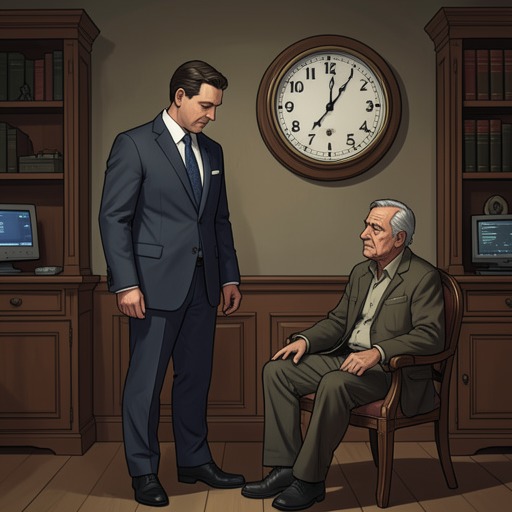
The educational pattern also reproduces competing ideas about work and ownership. Lechter describes Kiyosaki’s educated father as encouraging him to work for a corporation, while Rich Dad urged him to own one. Both paths required education, but the subjects and aims differed: one emphasized becoming a capable employee; the other, learning to bring capable people together. The contrast helps explain why the book treats education not as a single route to success but as a force that can prepare people for very different positions in economic life.
Households, Debt, and Generational Pressure
The gap becomes visible in the household cycle the book describes. A couple buys a home, takes on property tax and mortgage payments, then adds a car, furniture, appliances, and credit-card debt. When consumer balances become burdensome, a lender offers to fold them into the mortgage and spread repayment over thirty years. Lower monthly payments can feel like relief, but the debt has been transferred into the home loan rather than eliminated. The couple’s rising expenses then create pressure to earn more, while further borrowing keeps them in the cycle.
Kiyosaki argues that this predicament is often mistaken for an income problem. The couple may ask how to make more money, although the book identifies their spending decisions and failure to distinguish assets from liabilities as the more fundamental trouble. More income, by itself, seldom solves the problem, he says; financial understanding is needed to see where money goes and whether a purchase strengthens or weakens a household’s position.
The consequences extend beyond working-age households. Lechter and Kiyosaki raise the prospect of children supporting a large retiring population, including 75 million baby boomers, while Social Security and Medicare face financial strain. Lechter also warns that many Americans have little or nothing saved for retirement and questions the security of relying on a pension plan. Kiyosaki’s account of his 1994 retirement at age 47 offers a contrasting model: he defines retirement not as a permanent stop to work, but as the freedom to work or not while assets continue to grow. Mike, meanwhile, takes over his father’s business empire and prepares his own son to succeed him, making both wealth and responsibility explicitly intergenerational.
Asset-Building as a Proposed Response
The book’s proposed counter to the gap is to build assets before obligations and consumption take over. Kiyosaki urges adults to keep expenses low, reduce liabilities, and steadily accumulate assets; he particularly stresses teaching children to understand the distinction before they leave home, marry, and take on a house, children, and credit. He describes assets as holdings that produce income, appreciate, or have a ready market, including businesses run by others, stocks, bonds, mutual funds, income-generating real estate, notes, and royalties. In his account, acquiring an asset base can give a household a measure of financial independence unavailable through wages alone.
The distinction between an asset’s appearance and its cash-flow effect is central to this advice. A home may be treated as a person’s greatest asset, yet mortgage debt and related expenses can fill the liabilities column. Personal possessions can also inflate a paper estimate of net worth without providing lasting value: Kiyosaki recalls that a new car can lose nearly a quarter of its price as soon as it leaves the lot, and that his $400 titanium golf club was worth $150 once he had teed off. These examples support his warning that conventional measures of wealth may obscure how much cash an owner can actually generate or retain.
The book frames asset-building as a choice that should begin early, not as a reward reserved for people who already possess large sums. Kiyosaki says he turned $5,000 in cash into a $1 million asset producing $5,000 a month in cash flow in less than six years, while emphasizing that his learning began in childhood. The claim underwrites his insistence on starting small, learning, practicing, and acquiring financial knowledge rather than waiting for a large deal or a large nest egg.
Giving, Teaching, and the Circulation of Knowledge
The book also connects the wealth gap to whether knowledge and resources circulate. Kiyosaki presents both fathers as generous with what they knew, but contrasts their approaches to money: Rich Dad gave to his church, charities, and foundation, while his educated father intended to give only when he had extra money—a condition that, Kiyosaki says, rarely arrived. Rich Dad’s principle was to give first; the book turns that principle into a broader argument that teaching and giving can return value to the giver as well as the recipient.
Kiyosaki applies this idea to education itself. He says that teaching people who want to learn also deepens the teacher’s understanding, and that he became both a money-making capitalist and a socially concerned teacher troubled by the widening divide between haves and have-nots. Lechter similarly presents education as a means of helping parents prepare children for changing economic conditions. The proposed remedy is therefore not limited to individual investment: it includes passing financial knowledge to children and sharing it with others.
Significance and Limits of the Prescription
The book gives the Wealth gap an urgent public dimension through its warnings about outdated schooling, uncertain retirement provision, and the vulnerability of families who depend on wages and credit. Its final appeal makes financial choices personal and immediate: money may be spent on liabilities, invested in the mind, or used to acquire assets, and parents can choose whether to pass financial knowledge to their children. The gap is depicted as reproduced by habits and educational inheritance, but not as inevitable.
At the same time, the text’s answer places considerable weight on individual financial education, self-management, and investment. It criticizes inadequate schools and uncertain public support, yet emphasizes the choices households can make within those conditions. Its central tension is between a structural problem—the unequal distribution of knowledge, ownership, and security—and a proposed remedy focused on learning and personal action. The book’s image of financial education as a way to prepare the next generation makes that tension its defining argument: the divide persists through what families are taught, but the same transmission can be redirected.